
Introduction
You can stop bad pet habits without punishment by identifying the trigger, removing reinforcement, and
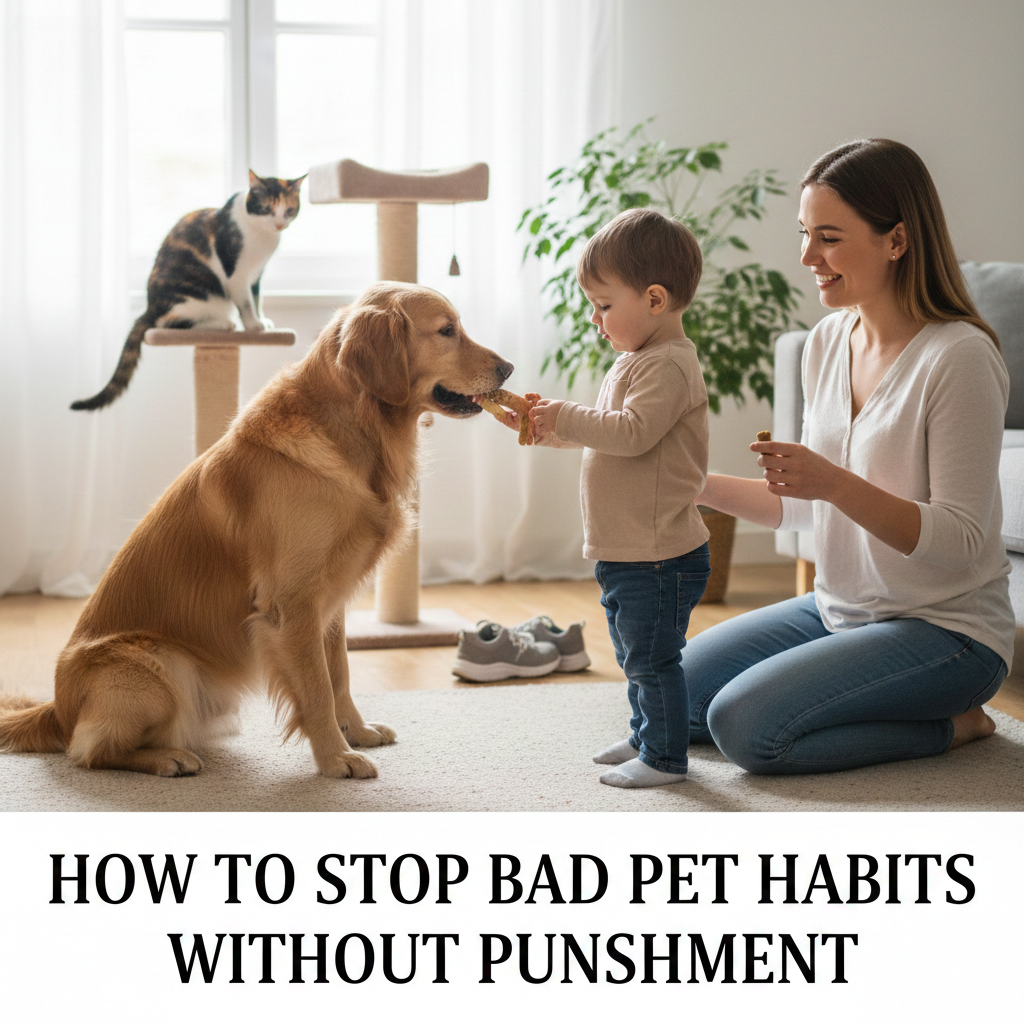
Stop bad pet habits without punishment by identifying the trigger, removing reinforcement, and teaching a clear replacement behavior. This humane approach works because it changes habits at their root—using how pets naturally learn, not fear or force.
Punishment may look effective in the moment, but it rarely solves the problem. It suppresses behavior temporarily while leaving the cause untouched. This guide explains how to stop bad pet habits—such as jumping, chewing, barking, or counter-surfing—without punishment, using practical, real-home methods. You’ll learn why punishment backfires, what to do instead, and how to build behavior that lasts.
teaching a clear replacement behavior. This approach changes habits reliably because it works with how pets learn—not against it.
Punishment often looks effective in the moment, but it rarely solves the problem. It suppresses behavior temporarily while leaving the cause untouched. This guide explains how to stop unwanted habits—like jumping, chewing, barking, or counter-surfing—using humane, practical methods that fit real homes. You’ll learn why punishment backfires, what to do instead, and how to build behavior that lasts.
Why Punishment Fails (Even When It “Works”)
Punishment stops behavior in your presence, not in your absence.
Common side effects:
Fear or avoidance
Increased anxiety
New problem behaviors
Loss of trust
From real training experience, punishment creates quieter pets—not better-behaved ones.
[Expert Warning]
If a habit returns when you’re not around, it was never fixed—only suppressed.
The Habit Loop: What You’re Really Changing
Every habit follows a loop:
Trigger → Behavior → Reward
Punishment targets the behavior only. Effective change targets all three.
| Habit Component | What to Adjust |
| Trigger | Reduce or manage it |
| Behavior | Interrupt gently |
| Reward | Remove payoff |
| Replacement | Teach an alternative |
SERP Gap Identified:
Most articles say “redirect” without explaining how habits are maintained by rewards.
Step 1: Identify the Real Trigger
Bad habits don’t appear randomly.
Common triggers include:
Boredom
Anxiety
Excitement
Hunger
Environmental cues
Example:
Jumping often starts with excitement
Chewing often follows boredom
[Pro-Tip]
Fixing the trigger shortens training time more than correcting the behavior.
Step 2: Remove the Reward (Quietly)
If a behavior continues, it’s being rewarded—sometimes unintentionally.
| Habit | Hidden Reward |
| Jumping | Attention |
| Barking | Reaction |
| Chewing | Stress relief |
| Counter-surfing | Food access |
Fix:
Block access, ignore calmly, or manage environment so the habit stops paying off.
Step 3: Teach a Replacement Behavior (The Missing Piece)
Stopping a habit without replacement creates confusion.
Examples That Work
Jumping → Sitting
Barking → Quiet focus
Chewing furniture → Chew toy
Door rushing → Waiting
Internal linking suggestion:
Link to Positive Reinforcement Training: How It Works
Anchor: “teaching replacement behaviors”
Step 4: Reinforce the New Habit Consistently
Replacement behaviors must be easier and more rewarding than the old habit.
| New Behavior | Reward Type |
| Calm greeting | Attention |
| Quiet focus | Treat or praise |
| Appropriate chewing | Long-lasting toy |
| Waiting | Access or freedom |
[Money-Saving Recommendation]
Consistency beats expensive tools—routine is the real solution.
Common Non-Punitive Fixes for Popular Habits
Jumping on People
Ignore jumping
Reward feet-on-floor
Ask for sit before greetings
Chewing Furniture
Remove access temporarily
Provide legal chew outlets
Increase enrichment
Excessive Barking
Identify trigger
Teach quiet cue
Reward silence
Counter-Surfing
Clear surfaces
Supervise or block access
Teach “place” behavior
Information Gain: Management Is Not Failure
Top SERP pages treat management (gates, leashes, crates) as temporary.
In real homes:
Management prevents rehearsal of bad habits
Fewer repetitions = faster habit change
Training progresses calmly
Using barriers isn’t cheating—it’s strategy.
UNIQUE SECTION: Beginner Mistake Most People Make
Mistake: Trying to stop the habit everywhere at once.
Behavior changes faster when:
One context is trained first
Success is repeated
Difficulty increases gradually
Fix one situation well before expanding.
A Simple Habit-Stopping Framework
Spot the trigger
Block the reward
Teach a replacement
Reward consistently
Reduce management gradually
| Sign | What It Means |
| Fewer attempts | Habit weakening |
| Faster recovery | Learning occurring |
| Calm baseline | Root cause addressed |
FAQs
Can bad habits be stopped without punishment?
Yes. Replacing behavior is more effective than suppressing it.
How long does habit change take?
Weeks, depending on consistency and habit strength.
What if my pet ignores replacement behaviors?
The reward may not be strong enough—or timing is off.
Is ignoring bad behavior always right?
Only when the behavior is safe and non-reinforcing.
Do barriers slow training?
No. They prevent habit rehearsal and speed progress.
Will habits return later?
They can if routines become inconsistent.
Conclusion:
Stopping bad pet habits without punishment works because it teaches pets what to do, not just what to avoid. By managing triggers, removing rewards, and reinforcing better choices, habits.
Internal link
Positive Reinforcement Training: How It Really Works
External link
https://www.petworks.com/


