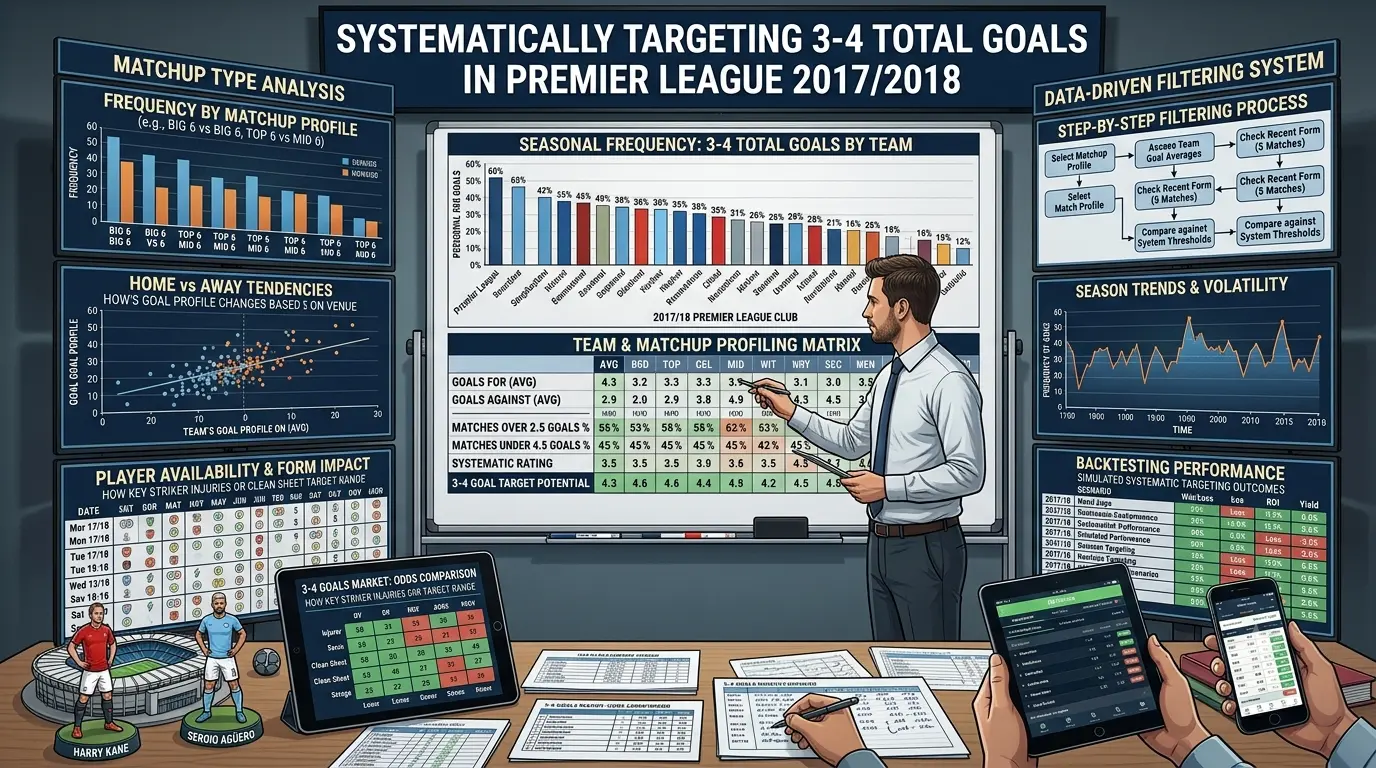
Predicting matches that land specifically in the 3–4 total goal range requires more precision than general over/under betting. In the 2017/2018 Premier League season, this outcome range often emerged from balanced attacking intent combined with moderate defensive vulnerability, rather than extreme styles.
Why the 3–4 Goal Range Is Structurally Distinct
Matches ending with 3–4 goals typically sit between chaos and control. Unlike high-scoring games, they do not spiral into open exchanges, and unlike low-scoring matches, they do not remain tactically restricted.
The cause is equilibrium between attacking efficiency and defensive resistance. The outcome is sustained chance creation without complete defensive collapse. The impact is a narrower but more predictable scoring band when specific conditions are met.
Team Combinations That Produced Mid-Range Scoring
Certain matchups repeatedly generated totals within this range due to how teams interacted tactically. These were not necessarily the highest-scoring teams, but those with compatible styles.
Before applying this insight, it is necessary to identify the structural traits behind these matchups:
- Teams with consistent but not explosive attacking output.
- Defenses that concede chances but recover shape quickly.
- Midfield battles that allow transitions without full breakdown.
- Balanced possession rather than extreme dominance.
- Strikers converting at average efficiency rather than streaky extremes.
These characteristics create controlled openness. Matches develop enough chances to reach multiple goals but lack the volatility required for extreme scorelines. For bettors, identifying this balance is key to isolating the 3–4 goal window.
Interpreting these traits requires moving beyond raw goal averages and focusing on interaction between teams.
The Role of Game Progression in Reaching 3–4 Goals
The path a match takes is often more important than the final number. Matches that reach 3–4 goals tend to follow specific scoring sequences.
Typical Goal Progression Patterns
Several patterns appeared consistently:
- Early goal followed by controlled response rather than immediate escalation.
- Evenly spaced goals across both halves.
- One team leading while the other pushes without losing structure.
- Late goals adding to totals without triggering chaos.
- Balanced shot distribution between teams.
These sequences prevent matches from becoming either too defensive or too open. The implication is that timing and pacing of goals matter as much as total attacking output.
Translating Patterns into Selection Criteria
To consistently identify these matches, bettors must filter out both low-variance and high-chaos fixtures. The goal is to isolate controlled attacking environments.
A structured selection model helps refine this:
- Avoid teams with extreme scoring profiles (very high or very low).
- Focus on mid-table teams with stable tactical identities.
- Evaluate recent matches for consistent goal ranges.
- Analyze head-to-head patterns for controlled scoring.
- Consider match importance and likelihood of balanced play.
This approach narrows the pool to matches where scoring distribution aligns with the 3–4 goal outcome. It reduces exposure to unpredictable extremes.
Applying this consistently transforms a niche market into a repeatable strategy.
Market Pricing and Mid-Range Outcomes
Unlike standard over/under markets, exact or narrow goal ranges are less efficiently priced. This creates subtle opportunities when patterns are correctly identified.
A pattern becomes evident when examining how odds are presented across a betting destination. ยูฟ่า168 เว็บแท้100% reflects broader market tendencies by focusing heavily on main goal lines, leaving mid-range outcomes less precisely calibrated. The implication is that bettors who specialize in this range can find value where pricing lacks depth.
When the 3–4 Goal Strategy Breaks Down
Even well-selected matches can fall outside this range due to unpredictable shifts in match dynamics. Recognizing failure conditions is essential.
Common breakdown scenarios include:
- Early red cards leading to unbalanced scoring.
- Rapid consecutive goals turning control into chaos.
- Defensive collapse from one side creating high-scoring outcomes.
- Missed chances keeping totals artificially low.
- Tactical shifts after halftime disrupting match balance.
These disruptions highlight the fragility of mid-range predictions. The impact is that precision strategies require strict filtering and acceptance of variance.
Expanding Insight Across Betting Contexts
The concept of targeting a narrow outcome range reflects a broader principle: value often exists in overlooked probability bands rather than mainstream markets.
An indirect observation supports this. In a casino online setting, outcomes that fall within specific ranges often receive less attention compared to extreme results, creating similar inefficiencies. The implication is that focusing on underexplored probability zones can reveal opportunities across different betting environments.
Integrating Data with Match Context
Raw statistics provide initial guidance, but contextual factors determine whether a match fits the 3–4 goal profile. Tactical intent, team motivation, and match tempo all influence outcomes.
The key is identifying when structural balance is likely to persist throughout the match. When that balance holds, the probability of landing within this range increases significantly.
Summary
Targeting 3–4 total goals in the 2017/2018 Premier League required identifying matches with balanced attacking and defensive characteristics rather than extreme tendencies. These outcomes emerged from controlled game progression and tactical equilibrium. Bettors who focused on team interaction, match flow, and market inefficiencies were better positioned to consistently identify opportunities within this specific scoring range.